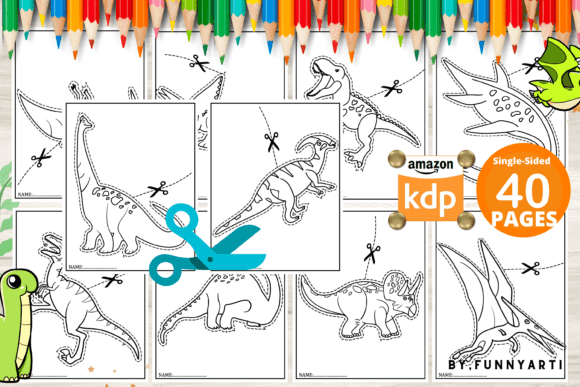
Dinosaur Scissor Skills Activity
The Dinosaur Scissor Skills Activity is a structured, printable resource designed to support early childhood development—specifically fine motor control, hand-eye coordination, and pre-writing readiness. It consists of 20 PDF pages and 20 high-resolution JPG files, plus a 41-page single-sided PDF optimized for printing (including bleed prevention for clean page separation). The package centers on dinosaur-themed tracing and cutting exercises, featuring cartoon-style illustrations suitable for preschoolers and kindergarten learners.
This activity is commonly used in home school settings, early learning classrooms, and therapeutic contexts where occupational therapists or educators guide children through progressive scissor practice. Unlike free online printables, this package offers consistent line weight, intentional spacing, and developmentally sequenced tasks—from simple straight lines to zigzags, curves, and enclosed shapes—each aligned with typical skill milestones for ages 3–6.
Parents and educators may consider the Dinosaur Scissor Skills Activity for several practical reasons. First, it provides a focused, screen-free alternative to digital learning tools during critical developmental windows. Second, its thematic consistency—dinosaurs as a high-interest subject—can increase engagement without requiring external motivation. Third, the single-sided 41-page version supports classroom use where individual pages are removed for display or assessment, avoiding ink transfer or obscured artwork on reverse sides.
Key benefits include measurable progress in fine motor development: improved pincer grip strength, bilateral coordination (using both hands together), and visual tracking while cutting along paths. Tracing elements also reinforce pencil control, spatial awareness, and pre-handwriting posture. Because the designs avoid excessive detail or tight corners, they reduce early frustration—important when building confidence in young learners still developing finger dexterity and attention stamina.
However, expectations should remain realistic. This is not a standalone curriculum but a supplementary tool. Children vary widely in readiness: some may begin cutting with assistance at age 3; others benefit from more guided practice until age 5 or later. Success depends less on the material itself and more on consistent, low-pressure repetition—ideally 5–10 minutes per session, 2–3 times weekly—with adult supervision for safety and feedback. Scissors must be child-safe and appropriately sized; blunt-tip models are recommended for beginners.
A notable tradeoff is format limitation. While the JPG files allow flexibility for digital projection or custom editing (e.g., resizing for laminated task cards), the PDFs are fixed-layout documents—not editable in standard software. Users seeking customizable text, adjustable difficulty levels, or multilingual versions will need to look elsewhere or adapt manually. Likewise, the dinosaur theme, while broadly appealing, may not resonate equally across all learners—some children show stronger interest in vehicles, insects, or community helpers, which could affect sustained participation.
This package fits best in specific situations. It is well-suited for homeschooling families who prefer ready-to-print, low-prep resources with clear developmental intent. It also works effectively in small-group kindergarten settings where teachers want differentiated cutting practice—e.g., assigning simpler pages to emerging cutters and more complex outlines to advanced peers. Therapists working with children who have mild motor delays may find the progression helpful as part of a broader intervention plan, especially when paired with verbal cues and physical modeling.
Conversely, alternatives may be preferable in other cases. For children with significant sensory sensitivities—such as aversion to paper texture or resistance to holding scissors—a tactile-based approach (e.g., playdough cutting, foam shapes, or adaptive tools) might precede or replace paper-based activities. Similarly, if the goal is broad creative expression rather than targeted motor refinement, open-ended art materials (scissors + collage supplies) offer more flexibility and self-direction. Teachers integrating literacy or math concepts may prefer cross-curricular resources that embed cutting within storytelling or counting tasks—something this package does not emphasize.
When evaluating whether the Dinosaur Scissor Skills Activity aligns with your goals, ask three questions: (1) Is the primary objective to build foundational cutting and tracing skills—not general creativity or content knowledge? (2) Do you value consistency in line thickness, spacing, and incremental challenge over customization or thematic variety? (3) Are you prepared to support practice with short, repeated sessions rather than expecting immediate mastery?
If the answer to all three is yes, this package offers efficient, developmentally grounded practice. Its design avoids common pitfalls—like overly thin lines that tear easily or dense patterns that overwhelm attention—making it more reliable than many free printables. The inclusion of both PDF and JPG formats adds utility across printing, digital display, and hybrid learning environments.
For those comparing similar products, note that quality hinges on usability—not just quantity. A 41-page single-sided PDF matters most if you plan to bind or laminate individual sheets; the “no-bleed” feature ensures clarity when pages are handled frequently. Meanwhile, the 20 JPG files serve users who need image-only assets—for example, inserting into interactive whiteboard lessons or creating custom flashcards. These details reflect thoughtful adaptation to real-world classroom and home constraints.
Finally, consider long-term fit. While dinosaurs hold lasting appeal for many young children, interest can shift quickly. If you anticipate needing multiple themes throughout the year (e.g., seasons, animals, transportation), evaluate whether this package’s niche focus meets your broader planning needs—or whether a modular system (e.g., interchangeable tracing/cutting templates by category) would provide greater versatility over time.
In summary, the Dinosaur Scissor Skills Activity is a purpose-built, printable resource grounded in early childhood motor development principles. It delivers consistent, age-appropriate practice within an engaging theme—but its effectiveness depends on how it’s integrated into daily routines, supported by adults, and matched to individual learner readiness. As one component of a balanced early learning toolkit, it offers practical value where precision, repetition, and structure support growth.