Scientist Bundle SVG 30 Designs: Practical, Print-Ready Science-Themed Graphics for Real Projects
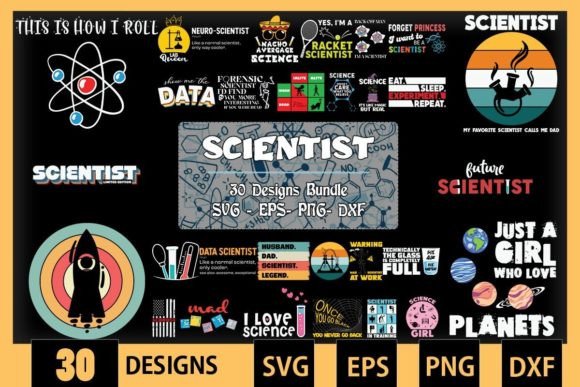
If you've ever spent hours searching for a clean, scalable “Lab Queen” or “Neuro-Scientist” design—only to find pixelated PNGs, mismatched colors, or licensing restrictions—you’ll appreciate what the Scientist Bundle SVG 30 Designs delivers: thirty thoughtfully crafted, science-inspired vector graphics, ready to cut, print, layer, or embed without compromise.
This isn’t just another clipart pack. It’s a working toolkit built for people who need flexibility—not fluff. Whether you're heat-pressing lab-themed shirts for a university outreach event, designing classroom posters for AP Chemistry, or launching a small-batch apparel line celebrating women in STEM, these files meet real-world production needs.
Where These SVGs Actually Get Used (Beyond the Obvious)
Teachers use them on editable Canva lesson slides—scaling “Eat Sleep Experiment Repeat” to full-banner size without blur. Science camp coordinators print “Future Scientist” and “I’d Find You Logic” onto vinyl name tags that survive outdoor labs and rain delays. Etsy sellers layer “Vintage Rocket Scientist” over distressed textures to create limited-run mugs that ship with handwritten thank-you notes—and consistently earn five-star reviews for “perfectly nerdy charm.”
Small business owners in the education space embed “Scientific Instruments - Scientist” into digital workbooks, then export crisp PDFs for school district procurement portals. Lab managers add “Mad Scientist At Work” to laminated safety signage—because humor lowers cognitive load during onboarding. Even data science teams drop “Show Me The Data” into internal Slack banners before sprint planning—turning culture-building into a one-click task.
Why File Format Variety Matters More Than You Think
The Scientist Bundle SVG 30 Designs includes SVG, DXF, EPS, and PNG (300 DPI)—not as marketing filler, but because each format solves a distinct problem:
- SVG: Your go-to for web use, Cricut Design Space, Silhouette Studio, or responsive digital presentations. It scales infinitely and edits cleanly in Figma or Illustrator.
- DXF: Essential for laser cutting acrylic lab coasters, engraving stainless steel beaker sleeves, or CNC-routing wooden periodic table wall art. No conversion headaches—just import and run.
- EPS: Still the gold standard for professional print shops handling large-format banners, trade show backdrops, or offset-printed conference swag. Keeps fonts and paths intact under press-ready workflows.
- PNG at 300 DPI: For quick social posts, email headers, or PowerPoint decks where vector support isn’t guaranteed—but resolution absolutely is.
That “Just A Girl Who Love Planets” design? It looks equally sharp on a 4" enamel pin die line and a 6' x 3' astronomy night backdrop—because the same source file adapts instead of forcing workarounds.
Who Benefits—and How Their Needs Differ
Educators care about clarity and curriculum alignment. They lean on “Biology Scientist” or “Forensic Scientist” to label lab stations—or pair “Forget Princess I Want To Be A Scientist” with career exploration units. Bonus: no copyright worry when projecting during parent-teacher conferences.
Small-Batch Makers prioritize production speed and material compatibility. “Chemist”, “Physic”, and “Nacho Average Science” convert flawlessly to iron-on transfers for cotton lab coats—and the clean vector edges prevent fraying during weeding. One maker reported cutting time dropped by 40% after switching from raster-based templates.
STEM Advocates & Nonprofits use “Once You Go Black You Never Go Back” and “My Favorite Scientist Calls Me Dad” in community workshops—knowing the inclusive, affirming messaging lands without needing redesign. The vintage aesthetic (“Retro Sunset”, “Scientist USA Flag”) also resonates across generational audiences at science fairs.
Remote Teams & Tech Orgs grab “Data Scientist”, “Programmer Cat Science”, and “Scientist In Training” for virtual backgrounds, sprint retrospective boards, or onboarding kits—adding levity without sacrificing credibility.
What to Consider Before You Start Using Them
First—check your software’s native support. While SVG works in most modern tools, some older versions of CorelDRAW or legacy embroidery software may require EPS or DXF. If you’re prepping for screen printing, confirm your vendor accepts vector outlines (not embedded rasters) to avoid trapping issues.
Second—think about context before customizing. That “Warning Mad Scientist” badge reads brilliantly on a coffee sleeve, but might feel tone-deaf on hospital lab door signage. Similarly, “Yes I’m A Racket Scientist” leans playful; “Scientific Instruments - Scientist” reads more formally—choose based on audience expectations, not just visual appeal.
Third—review color mode. All designs are RGB-ready for digital use, but if you’re printing commercially, convert to CMYK *after* final layout (not within the SVG itself) to preserve editability. The bundle doesn’t include Pantone references, so brand-matching requires manual calibration—something to note if consistency across 50+ t-shirts matters.
Strengths That Solve Real Problems
The biggest win? Time saved on sourcing and vetting. Instead of juggling ten different free-resource sites—each with inconsistent licensing, mixed resolutions, or watermarks—you get one cohesive set, fully cleared for commercial use (including resale on physical products). No attribution required. No surprise TOS updates.
The thematic range avoids cliché: “Technically the Glass Is Completely Full” speaks to resilience; “Science Doesn’t Care What You Believe” anchors evidence-based dialogue; “SCIENTIST Funny Job Limited Edition” adds wink-without-wink merch energy. It’s science communication that breathes—not lectures.
And unlike AI-generated bundles, these were clearly hand-tuned: consistent stroke weights, intentional negative space, balanced typography (where text is included), and smart grouping—so “Eat Sleep Experiment Repeat” imports as one logical object, not 17 unlinked paths.
A Few Honest Limitations
These aren’t animated or interactive—so they won’t work for web apps requiring hover states or SVG filters. There’s no font file included, meaning text-based designs (like “Back Off Man I’m A Scientist”) rely on system fonts unless you outline type first. And while the 30 designs cover broad ground—from physics to forensic science—they don’t include specialty symbols like CRISPR diagrams or quantum circuit icons.
Also worth noting: the “Vintage” and “Retro” styles intentionally use muted palettes and grain overlays. That’s a strength for authenticity—but if your brand mandates neon gradients or ultra-minimalist lines, minor tweaking in Illustrator will be needed.
In short, the Scientist Bundle SVG 30 Designs shines where precision, adaptability, and human-centered science storytelling intersect—not as decoration, but as functional, expressive infrastructure for educators, makers, communicators, and teams building something real.