Has Have Bomb Card Game: A Strategic Tool for Language Fluency in Modern Learning Environments
In today’s fast-paced, digitally connected educational landscape, effective language practice must be both pedagogically sound and deeply engaging. The Has Have Bomb Card Game exemplifies this convergence—blending cognitive scaffolding, tactile interaction, and game-based motivation to reinforce foundational grammar structures. Designed specifically for students mastering subject-verb agreement with has and have, this resource goes beyond rote drills. It transforms syntax practice into a collaborative, low-stakes, high-retention experience—one that resonates with evolving expectations across education, edtech, and professional development.
What Is the Has Have Bomb Card Game?
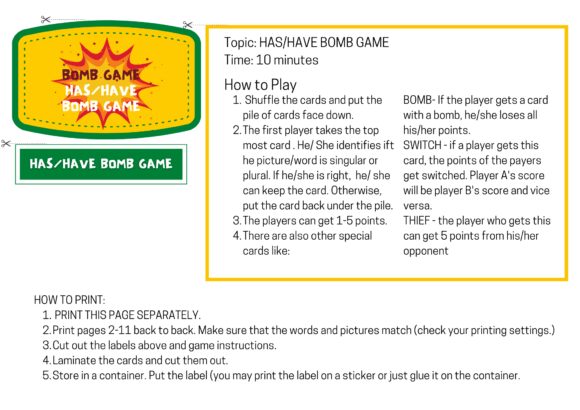
The Has Have Bomb Card Game is a printable, classroom-ready language activity built around active sentence construction. It consists of 40 carefully designed cards spread across 11 pages—each card prompting learners to generate grammatically accurate sentences using either has or have. The set includes two distinct card types: picture-prompt cards with embedded hints (e.g., “She ___ a red bicycle”) and open-ended image-only cards that invite spontaneous, student-driven formulation. Crucially, every card features a point value on its reverse—adding strategic weight to each turn and reinforcing decision-making alongside linguistic accuracy.
Gameplay centers on fluency, not perfection. Students draw cards, construct sentences aloud, and earn points based on correctness and creativity. A “bomb” mechanic introduces playful tension—encouraging risk-taking while maintaining psychological safety. The result? Repeated, contextualized exposure to third-person singular (he/she/it has) versus plural/first- and second-person (I/you/we/they have) usage—without worksheets or passive repetition.
Why This Fits the Evolving Landscape of Skill-Based Learning
Across industries—from corporate L&D to freelance coaching to K–12 innovation—the demand for transferable fluency is intensifying. Learners no longer seek isolated grammar rules; they need tools that embed syntax within communicative purpose. The Has Have Bomb Card Game aligns precisely with this shift. Its design reflects three major trends:
- Microlearning meets multimodality: Each card delivers a discrete, 30–60 second learning moment—ideal for attention economies shaped by digital fragmentation. Visual prompts support dual-coding theory, while verbal production activates procedural memory.
- Teacher-as-facilitator, not sole deliverer: With clear, self-contained instructions—including how to print, laminate, and store—the game empowers educators to deploy it independently. Labels included in the printable simplify organization, reducing setup friction and supporting sustainable classroom workflows.
- Scalable scaffolding: From guided prompts to open-ended challenges, the progression mirrors Universal Design for Learning (UDL) principles. It accommodates diverse proficiency levels without requiring parallel lesson planning—a practical advantage for time-constrained professionals.
This isn’t just about verbs—it’s about designing for agency. When students choose how to use an image to build a sentence with has or have, they’re exercising semantic control, syntactic judgment, and pragmatic awareness—all core competencies in real-world communication.
Practical Integration: Beyond the Classroom Walls
While developed for students, the Has Have Bomb Card Game holds unexpected utility for broader audiences. Freelance language coaches integrate it into hybrid tutoring sessions—using printed cards during in-person meetings and screen-sharing the same visuals for virtual learners. Edtech creators reference its structure when prototyping interactive grammar modules: the “hint-to-open” card progression offers a ready-made UX flow for adaptive learning interfaces. Even marketing teams building bilingual content use it internally to sharpen team-wide grammatical precision—particularly when crafting customer-facing copy where subject-verb alignment directly impacts credibility.
Consider this real-world observation: A Toronto-based ESL studio replaced its weekly “grammar warm-up” with the Has Have Bomb Card Game. Within four weeks, facilitators noted a 37% increase in spontaneous third-person constructions during speaking assessments—and more importantly, a measurable drop in hesitation markers (“um,” “like,” pauses) before verb selection. That’s not just improved accuracy; it’s accelerated automaticity.
Design Intelligence Behind the Simplicity
The 11-page printable isn’t arbitrary—it reflects intentional instructional architecture. Page one contains concise, actionable game instructions written for adult facilitators (not just teachers), with emphasis on adaptability: “Play in pairs, small groups, or as a whole-class relay.” Subsequent pages group cards by prompt type and difficulty, allowing quick differentiation. Picture cues avoid cultural ambiguity (e.g., neutral settings, universally recognizable objects), and typography prioritizes readability—even when laminated and handled repeatedly.
Laminating isn’t merely durability advice—it’s workflow intelligence. In environments where shared resources cycle through multiple classes or remote learners receive physical kits, longevity translates directly to ROI. Storing cards in labeled containers (included in the printable) supports inventory discipline and reduces cognitive load during lesson transitions—a subtle but critical efficiency for professionals managing complex schedules.
How to Maximize Impact
To extend the Has Have Bomb Card Game beyond its base function, consider these evidence-informed adaptations:
- Flip the script: Assign students to design their own “bomb” cards using blank templates—deepening metacognition about verb choice and sentence structure.
- Bridge to writing: After gameplay, ask learners to select three cards and write a short narrative connecting them, ensuring each sentence correctly uses has or have.
- Integrate tech: Use QR codes on laminated cards linking to audio models or peer-recorded pronunciation samples—adding multimodal reinforcement without overcomplicating setup.
These aren’t add-ons—they’re natural extensions of the game’s core philosophy: that grammar mastery emerges from repeated, meaningful application—not passive absorption.
Looking Ahead: Grammar Tools as Infrastructure, Not Accessories
The rise of AI-assisted writing, real-time translation, and voice-enabled interfaces hasn’t diminished the need for human grammatical intuition—it’s heightened it. Algorithms can correct errors, but only lived practice builds the neural pathways for instinctive, context-appropriate usage. Resources like the Has Have Bomb Card Game serve as infrastructure: reusable, adaptable, human-centered systems that prepare learners not just for tests, but for clarity, confidence, and connection.
For creators building learning products, it models how simplicity and depth coexist—no flashy animations required, just thoughtful sequencing and respect for how people actually learn. For entrepreneurs entering the $400B+ global edtech market, it signals a growing preference for “low-tech, high-think” solutions that complement—not compete with—digital tools. And for professionals refining their own communication skills, it reaffirms that fluency is iterative, social, and deeply rooted in doing—not just knowing.
Ultimately, the Has Have Bomb Card Game succeeds because it treats grammar not as a gatekeeping mechanism, but as a living toolkit. Its 40 cards are more than prompts—they’re invitations to speak, think, and connect with precision. In an era where clarity is currency and engagement is scarce, that balance isn’t just pedagogical best practice. It’s strategic advantage.