Back to School Books and Apples: A Thoughtful Choice for Seasonal Embroidery
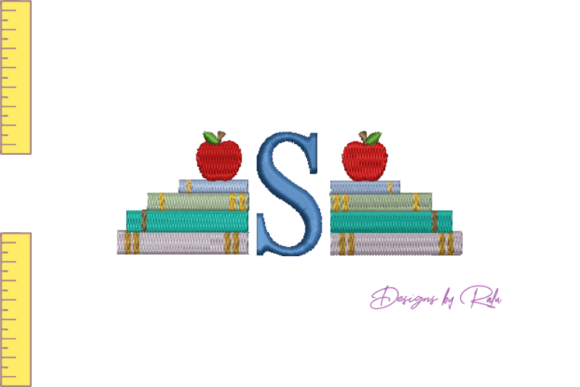
Back to School Books and Apples is a cohesive, machine-embroidery-ready design that merges two enduring symbols of learning—stacked books and fresh apples—into a balanced, narrow composition. Unlike many back-to-school motifs that prioritize either whimsy or realism, this design leans into intentional structure: bookends frame a vertical stack of open and closed books, with apples nestled naturally among the spines and covers. The result is neither cluttered nor sparse—it’s filled, grounded, and scalable. Its narrow profile makes it especially suitable for items where width is constrained: children’s backpack straps, toddler-sized t-shirt pockets, face mask panels, and infant onesies.
What Sets This Design Apart from Other Back-to-School Motifs
Most seasonal embroidery designs fall into one of three categories: text-heavy (“First Day of Kindergarten!”), character-driven (cartoon apples or smiling school buses), or abstract (geometric pencils or minimalist chalkboards). Back to School Books and Apples occupies a middle ground—it’s symbolic without being literal, decorative without sacrificing clarity, and detailed without requiring dense stitching density. The inclusion of both bookends and layered books adds structural integrity to the composition, which helps maintain visual balance even at smaller sizes (e.g., 3.5 inches tall). That structural logic also supports clean monogram integration: a single initial fits neatly within the negative space between the top apple and the uppermost book spine, or centered below the stack—ideal for personalized kindergarten gifts or teacher appreciation items.
Unlike clipart-style downloads that rely on flat outlines or heavy fill stitches, this design uses varied stitch types—including satin borders, tatami fills, and strategic underlay—to ensure fabric stability across cotton knits, twill, and lightweight canvas. That attention to technical execution means fewer re-hoops, less thread breakage, and better results on beginner-friendly machines like Brother PE series or Janome Memory Craft models—as well as high-end multi-needle setups.
Fitting the Design to Real-World Use Cases
Practicality matters when choosing embroidery files. Back to School Books and Apples ships in multiple formats (.dst, .pes, .jef, .vp3, .exp), covering most major home and small-batch commercial machines. That format flexibility reduces compatibility friction—a common pain point when sourcing designs from independent creators. It also means you’re not locked into a single ecosystem. If you switch machines next year, the file remains usable.
Consider how the design functions across applications:
- T-shirts and onesies: The narrow footprint avoids stretching across seams or distorting over shoulders. On a size 2T shirt, it centers cleanly over the chest without crowding armholes.
- Backpacks and lunchboxes: Works well on curved surfaces like rolled-top backpack flaps, where wide horizontal motifs often pucker or misalign.
- Face masks: At 2.75–3.25 inches tall, it fits comfortably within standard adult and child mask embroidery zones without overlapping ear loops.
- Classroom labels and cubby tags: When stitched onto twill tape or laminated fabric strips, the clear silhouette reads easily at a glance—even upside down.
This adaptability isn’t accidental. The design avoids fine interior details (like tiny letters on book spines or apple stems thinner than 0.3 mm) that would vanish at small scales or cause thread tension issues on unstable fabrics. Instead, it relies on shape, contrast, and rhythm—qualities that translate reliably across materials and sizes.
When Back to School Books and Apples Fits—and When It Might Not
This design excels when your goal is recognition, warmth, and subtle tradition—not novelty or trend-driven flair. It’s a strong match for educators preparing welcome kits, parents personalizing first-day outfits, or small-batch crafters building a consistent seasonal line. Its tone is gentle but purposeful: it signals readiness, care, and continuity—not competition, pressure, or overscheduling.
That said, it may not serve every need. If your project calls for:
- Bold, oversized statements (e.g., a 6-inch-wide “CLASS OF 2030” banner), the narrow stack won’t provide the visual weight needed.
- Themed variety (e.g., coordinating apples, rulers, globes, and notebooks across a set), this design stands alone—it doesn’t come with companion motifs or color variants.
- Digital-only use (social media graphics, printable PDFs), its embroidery-specific construction—like jump stitches and pull compensation—won’t translate directly to screen display without vector redrawing.
- Highly customized narratives (e.g., a child’s name woven into book titles), it offers monogram placement but no built-in text elements or editable text layers.
In those cases, evaluating alternatives—such as scalable vector packs, SVG-based cut files, or multi-motif bundles—may better align with your workflow or audience expectations.
Comparing Execution Quality Across Similar Resources
Among embroidery designs tagged “back to school,” quality varies widely—not just in aesthetics, but in digitizing rigor. Some files skimp on underlay, leading to gapping on knit fabrics. Others overload detail, causing slow stitch-out times or skipped needles on older machines. Back to School Books and Apples avoids both extremes: its stitch count falls within typical home-machine limits (roughly 8,200–9,400 stitches depending on size), and its underlay strategy accounts for directional grain in both woven and stretch fabrics.
You’ll notice the difference when embroidering on real garments. On a soft cotton jersey onesie, the apple curves hold shape without puckering. On a stiff denim backpack pocket, the book spines remain crisp, not blurred by excessive density. That consistency reflects experience—not just artistic skill, but knowledge of how thread, needle, fabric, and machine interact.
Still, it’s worth checking your own setup before committing. If you regularly embroider on performance fabrics (e.g., moisture-wicking polyester blends) or textured materials (corduroy, fleece), test the design on a scrap first—even well-digitized files behave differently off standard cotton.
Making a Practical Decision
Choosing Back to School Books and Apples isn’t about finding the “best” back-to-school design overall. It’s about matching form, function, and intention. Ask yourself:
- Do I need a design that works reliably across multiple garment types—not just one ideal use case?
- Is monogram integration essential, and do I prefer a clean, centered option rather than tucked into a corner or wrapped around a shape?
- Do I value technical reliability (stitch count, format coverage, fabric versatility) as much as visual appeal?
- Am I creating for an audience that responds to quiet symbolism—teachers, early-childhood professionals, or families who associate apples and books with steady, supportive learning?
If most answers are yes, this design earns serious consideration. If your needs skew toward maximalist energy, narrative customization, or digital-first delivery, other resources may suit better—even if they lack the same level of embroidery-specific refinement.
Ultimately, Back to School Books and Apples represents a thoughtful convergence: of iconography and utility, of tradition and technical awareness, of simplicity and substance. It doesn’t shout. But when stitched thoughtfully, it holds space—on fabric, in memory, and in the quiet rituals that mark another school year beginning.